What Kinship Adoption Teaches Us About Family
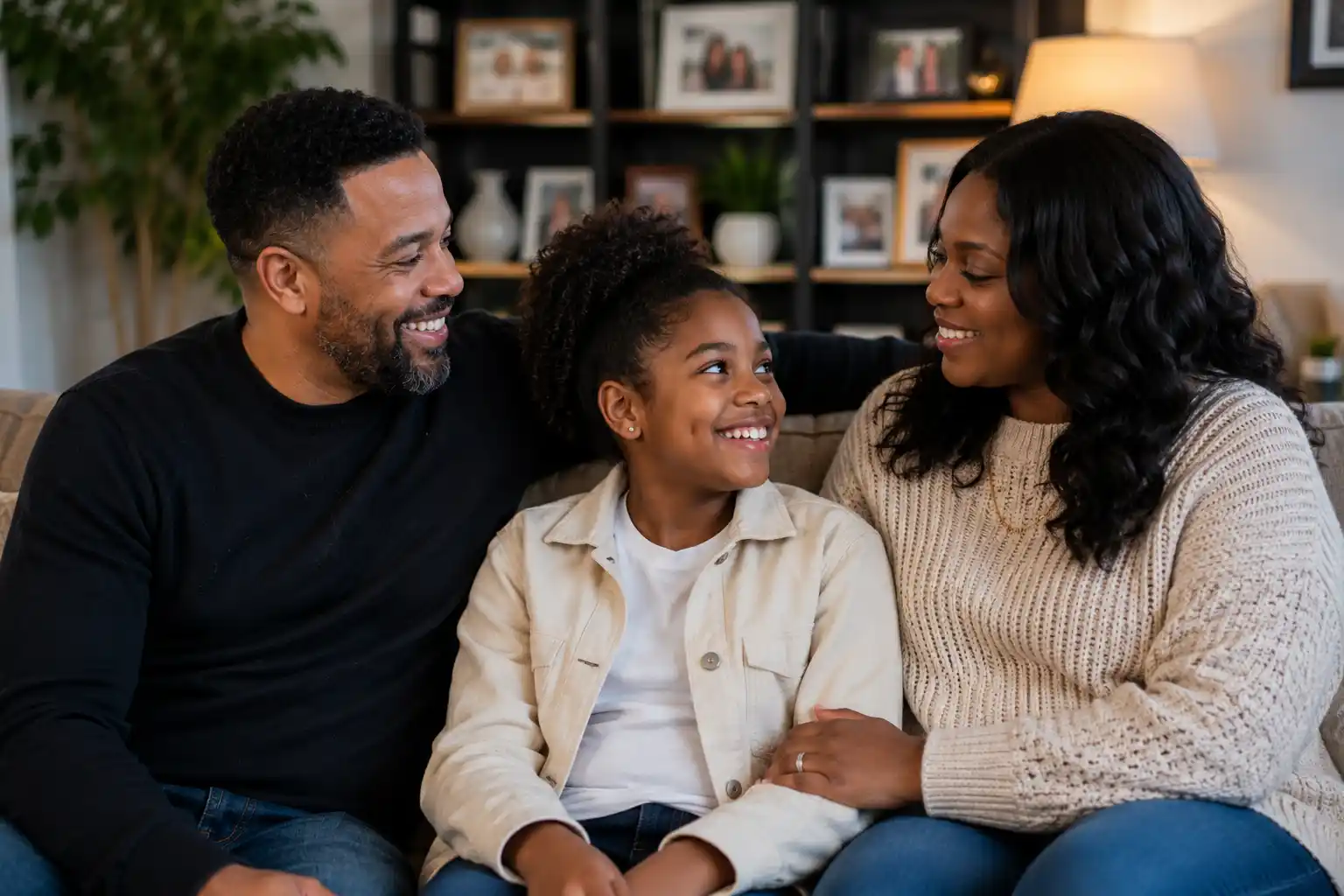
Family doesn't follow a single blueprint. Brian and Lachandra Baker know this better than most. Their family tree is a tangle of biological connections, legal adoptions, and deliberate choice. And they wouldn't have it any other way. As co-hosts of Everything's Not Black and White, they've built a space to explore the nuances of identity, relationships, and lived experience. But their real expertise comes from living it: raising a deeply blended, interracial family where adoption isn't a one-time event but a recurring thread that shapes who they are, how they love, and what family means.
The Adoption That Started It All
For Brian, adoption came late. At twenty-one years old, long past the age when most adoption conversations happen, his father asked if he could legally adopt him. Brian was already an adult, fully grown. He could have said no. Instead, he said yes. His biological father had been absent since conception, a pattern that left a hole Brian was ready to fill. Watching his father step into his life when Brian was young, offering stability and presence that his biological dad never could, Brian saw adoption not as a legal formality for children but as a statement of permanent choice. When he took his father's last name, he wasn't gaining a parent. He was confirming one he already had.
Lachandra had her own adoption thread woven through childhood. When her father married her mother, who already had Lachandra's older sister, he didn't hesitate. He adopted Lachandra's sister to make the family official, to give her the security of a shared last name and belonging. In fiscal year 2024, 30% of children in foster care in the United States were placed with relatives (Child Trends), and many of those placements eventually moved toward formal adoption to create legal permanence. For Lachandra's family, adoption was the antidote to abandonment. It said: you are part of us, legally and irreversibly.
When Kinship Becomes Choice
Years later, when Lachandra brought her son Aujie into the relationship with Brian, Aujie was six years old. Lachandra had raised him as a single mother with the support of her mother and sister. Aujie's biological father had exited when Lachandra was two months pregnant. But here was Brian, a man who understood the power of a father's presence, ready to show up not just as a boyfriend but as a parent. The question wasn't immediate. When Aujie was ten, Brian and Lachandra made it deliberate. They sat down with Aujie and asked: do you want this to be official? Do you understand what that means?
Aujie said yes. At ten years old, Aujie had a choice, something many adoptees never get. That choice matters. It's the difference between something done to you and something you participate in. Approximately 37% of children adopted from foster care in fiscal year 2024 were living with a relative or kin caregiver immediately prior to adoption (National Council for Adoption). Kinship adoption isn't a fringe pathway. It's one of the most common ways American families are made permanent. And when those adoptions include the child's voice, like Aujie's did, they don't just create legal families. They create chosen ones.
The Real Work of Allyship
The Baker family's story extends beyond internal bonds. It's a story about navigating an external world that doesn't always see their family as legitimate. As an interracial couple (Brian white, Lachandra Black), they've faced racism, microaggressions, and the constant burden of educating people around them. Early in their marriage, a neighbor used a racial slur within earshot, assuming Brian would agree. Brian didn't correct him in the moment; he held his space. He let his wife meet the neighbor. And he watched the neighbor's discomfort when he realized what he'd said. It took Brian years to tell Lachandra. He was protecting her from a bad first impression in their new home. But what he was really protecting was her peace.
Interracial marriages are no longer rare. About 17% of newlyweds in the United States marry someone of a different race or ethnicity (Pew Research Center), and 94% of Americans now approve of interracial marriage (Gallup), up from 4% in 1958. But statistics don't tell the whole story. There's still a cost to being Black in America, and Lachandra lives that cost daily. Brian's job, as an ally, is to absorb some of that weight, not by speaking over her or saving her, but by understanding her reality and using his privilege responsibly. That's allyship: not the performative kind, where someone swoops in to rescue. The kind where you ask, what does support look like to you? Where you clear the path rather than speak for someone.
Building a House of Empathy
The Bakers call their household "a house of empathy." It's a deliberate construction. Their core operating principle, drawn from Lachandra's work in nonprofit spaces, is "nothing about us without us." When you make decisions about someone else's life, they need to be at the table. Not as an afterthought. Not as someone to be saved. But as the expert on their own life. This shows up in how they parent: when their youngest, Aujie, bought their first car, Brian didn't hand over keys. He walked alongside, helping research, teaching how to maintain it, and showing up when a bumper got damaged in the first week. The lesson wasn't just about cars. It was about resilience, competence, and knowing someone has your back even when you fail.
The same applies to the community. Instead of taking the white-savior approach (donating a basketball hoop as though they were fixing a problem), the Bakers asked themselves: what skills do we have? What would actually serve people long-term? When they found a broken basketball hoop in their neighborhood, they didn't announce their generosity. Lachandra knocked on the door. Brian stayed back. They let the families own the gift. That's what building a house of empathy looks like: not the kind of family you planned, but the kind you needed. After eighteen years of marriage, the Bakers know what makes family real. It isn't biology. It's choice. It's showing up. It's asking what people need instead of deciding for them.
Definitions
Kinship adoption: The legal adoption of a child by a relative or close family friend, such as a grandparent, aunt, uncle, sibling, step-parent, or someone with a pre-existing family bond. Kinship adoption preserves family connections while providing legal permanency.
Adoption triad: The three groups affected by an adoption: birth parents, adoptive parents, and the adoptee. Healthy adoption practice honors all three voices.
Allyship: The active practice of using one's privilege to support and stand alongside members of marginalized groups without speaking over them or centering oneself.
Blended family: A family formed when one or both partners bring children from previous relationships into a new household, often involving step-parent or kinship adoptions to formalize bonds.
For anyone considering kinship adoption or considering being adopted, the Bakers' advice is simple: keep your heart and mind open. You'll stumble. You'll make mistakes. You'll say things that need correcting. But if you're willing to learn, to listen, and to put the other person at the center, family will happen. No matter where you are in your journey, you'll find people who understand.
Download Your FREE Guide to Adoption at VoicesofAdoption.org, listen to the full episode, and join a community where every voice in the adoption triad matters.
#VoicesofAdoption #KinshipAdoption #BlendedFamily #AdoptionStories #FamilyMatters #FamilyBeyondBiology #AdoptionCommunity #Allyship #FamilyChoice #AdoptionAwareness
Follow Voices of Adoption
Website: VoicesofAdoption.org | YouTube: @VoicesofAdoptionShow | Twitter/X: @Voices_Adoption | Instagram: @Voicesof_Adoption | Facebook: Voices of Adoption | TikTok: @Voices_of_Adoption | LinkedIn: Voices of Adoption
Donna Pope: LinkedIn
Nathan Gwilliam: LinkedIn
Connect with Lachandra B. Baker
LinkedIn: @lachandrabbaker | Instagram: @lbbedutainment
Connect with Brian B. Baker
Instagram: @bcourageous1.bb
Podcast - Everything's Not Black and White
Website: LBB-Edutainment.odoo.com/Podcast | YouTube: @LBBEdutainment